

Professionals spend years building trust, credibility, and meaningful business relationships, yet very few ever learn how to monetize their professional network practically. Most networking efforts focus on career growth, partnerships, or visibility, while the income potential behind those relationships often goes untouched. That is starting to change. More executives, consultants, retirees, and business professionals now look for ways to create recurring income without launching another demanding business or becoming full-time salespeople.
Many business owners already know that they are struggling with operational costs, outdated vendor contracts, or inefficient systems. The opportunity often exists within the relationships they already have.
In this article, we will explore how to monetize your professional network through referral partnerships, relationship-based business models, consulting opportunities, and recurring income strategies.
We will also look at why trust-driven business ecosystems are growing rapidly and how experienced professionals can turn existing connections into long-term financial leverage without heavy overhead or complex operations.
How to Monetize Your Professional Network?
Understanding how to monetize your professional network starts with a simple idea. Businesses consistently overspend in areas they rarely review carefully. Technology contracts, merchant processing, healthcare administration, lending structures, operational systems, payroll services, telecommunications, and commercial payment systems often contain hidden-in-plain-sight inefficiencies.
Business owners usually do not have time to investigate every vendor relationship. They stay focused on growth, hiring, customer acquisition, and daily operations. Our guide on why cost reduction goes to outside specialists walks through how that decision typically gets made inside a company. Because of that, they rely heavily on trusted recommendations. That creates an opportunity for professionals with established relationships.
Instead of selling products directly, many professionals now earn by introducing companies to vetted service providers capable of reducing costs or improving operations. When savings are delivered, compensation follows.
The reason this model attracts experienced professionals is simple. It avoids many of the headaches attached to traditional entrepreneurship. There is no inventory. No office lease. No payroll. No customer support department. No massive startup investment. In many relationship-based models, the professional simply opens the door. The operational work happens elsewhere.
Aspire Partners built its business around this concept. Through its network-driven model, professionals introduce businesses that may benefit from cost-reduction evaluations. Aspire Partners and its vendor network handle the audits, analysis, implementation, and contracts. The professional maintains the relationship. The vendors execute the solution.
That distinction matters because many highly connected professionals do not want another demanding business. They want a structured income stream built around relationships they have already spent years developing.
Why Relationship Capital Has Become More Valuable Than Attention
For years, online business culture pushed the idea that audience size determined earning potential. Build followers. Create content. Grow subscribers. Launch courses. Sell memberships.
That strategy works for some people. But many experienced professionals have something more valuable than internet attention. They have credibility.
A retired healthcare executive with relationships across hospital systems may possess more monetizable value than a creator with 200,000 followers. A former logistics consultant who knows regional manufacturers may hold a stronger business influence than someone producing motivational videos online. Trust has become currency.
McKinsey research continues to show that B2B purchasing decisions rely heavily on trusted recommendations and professional referrals rather than advertising alone. Buyers want reassurance from people they already know. That shift explains why referral ecosystems continue expanding across industries.
Professionals with strong networks now occupy a unique position inside the modern business economy. They already know decision-makers. They already understand industry pain points. They already have credibility established over years or decades.
The difficult part is finding a monetization structure that feels ethical and sustainable. That concern stops many professionals before they begin. They worry about damaging relationships. They worry about appearing transactional. They worry about turning networking into selling. But here’s what changes the equation.
A relationship-based referral model works best when it solves legitimate business problems. If a business owner saves money, improves efficiency, or discovers a better operational solution, the referral creates value for everyone involved. That changes the emotional dynamic entirely.
The Difference Between Audience Monetization and Professional Network Monetization
Audience monetization and professional network monetization often get grouped online, but they operate very differently.
Audience monetization depends heavily on content creation, visibility, algorithms, and ongoing engagement. Influencers, creators, coaches, and online educators typically monetize communities through advertising, sponsorships, subscriptions, digital products, or affiliate marketing.
Professional network monetization relies more on relationships, trust, business access, and industry credibility. The distinction matters because many professionals have no interest in becoming public personalities.
They do not want to spend years building a creator brand. They do not want to livestream every day. They do not want to become social media or entertainers. They simply want to create income from business relationships already built through their careers.
The table below highlights the difference.
| Audience Monetization | Professional Network Monetization |
| Depends on followers and content | Depends on relationships and trust |
| Often consumer-focused | Usually B2B-focused |
| Requires constant content output | Requires strategic introductions |
| Income tied to engagement metrics | Income tied to business outcomes |
| Competitive creator landscape | Relationship-driven opportunity |
| Public-facing personal brand | Private professional credibility |
This distinction explains why professionals increasingly explore referral-based opportunities instead of creator-driven business models. The barrier to entry feels lower. The operational burden feels smaller. And the work aligns more naturally with existing professional experience.
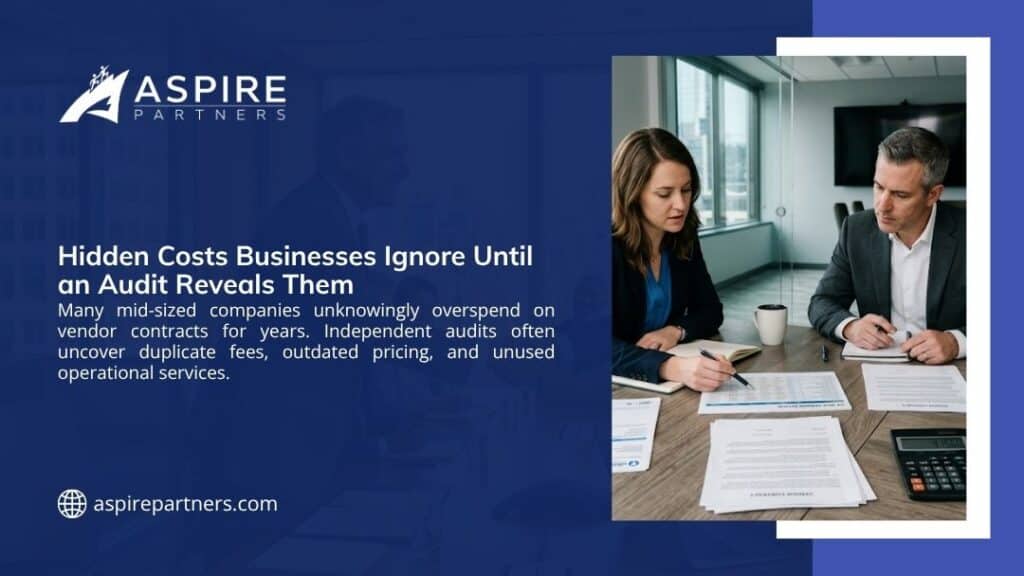
The Most Effective Ways to Monetize Business Relationships
Professionals monetize relationships in several different ways. Some launch consulting practices around specific industry expertise. Others build advisory firms. Some pursue affiliate marketing opportunities tied to niche audiences. Others monetize communities through memberships and educational content.
But referral partnerships continue gaining traction because they allow professionals to earn without managing the delivery side of the business.
The structure works especially well for professionals who maintain relationships with business owners, CFOs, operations leaders, healthcare administrators, or executives responsible for operational spending. The monetization model depends less on persuasion and more on access.
A former telecom executive, for example, may know dozens of companies paying excessive technology costs. A manufacturing consultant may understand which companies struggle with operational inefficiencies. A healthcare advisor may know organizations frustrated by revenue cycle problems. In many cases, those introductions alone hold measurable value.
Aspire Partners operates inside this framework by connecting professionals with cost-reduction and operational service opportunities across multiple industries. Its services include technology audits, preventative healthcare solutions, commercial payment systems, lending services, healthcare revenue cycle management, and legal protection programs.
Professionals who participate in the model are not expected to manage implementation. The operational teams and vendor partners handle the execution. That separation between introduction and fulfillment significantly lowers friction for professionals who dislike direct sales.
Why Most Professionals Never Monetize Their Networks?
Many professionals underestimate the value of their relationships. They assume monetization requires aggressive selling. Or they believe recurring income opportunities belong only to influencers, franchise operators, or startup founders.
But the hesitation usually comes from deeper concerns. Some fear damaging long-term relationships. Others feel uncomfortable discussing money. Many simply lack a structured system. Without infrastructure, relationship monetization becomes difficult.
A professional may know dozens of business owners facing operational problems but have no trusted solution provider to recommend. Without operational support, vendor management, implementation systems, or audit expertise, the professional remains stuck.
That problem explains why structured partner ecosystems continue expanding. The infrastructure already exists. The vendors already exist. The operational process already exists. The professional contributes to the relationship access. This approach reduces complexity dramatically.
Instead of building an entire consulting company from scratch, professionals can participate in established systems designed to handle fulfillment.
That structure appeals strongly to retirees, former executives, fractional consultants, and advisors who value flexibility. Many are not searching for another full-time career. They simply want recurring income connected to the relationships they already maintain.
The Rise of Low-Overhead Referral Business Models
Traditional business ownership carries significant overhead.
- Payroll.
- Liability.
- Inventory.
- Operations.
- Marketing.
- Customer acquisition.
- Administrative systems.
That reality explains why many experienced professionals hesitate before launching another company. If you are weighing which venture suits your next chapter, our guide to the best business to start after retirement with no overhead compares seven options side by side. Low-overhead referral models reduce much of that burden. The professional focuses on introductions and relationship management while operational teams handle the technical execution.
This model has expanded rapidly because modern businesses increasingly outsource specialized operational functions. Companies no longer expect one provider to handle everything internally.
Instead, they rely on specialists. Technology optimization firms. Healthcare administration experts. Commercial lending advisors. Payment automation providers. Revenue cycle management specialists. Businesses need trusted access to these services. Professionals with established networks can bridge that gap.
Aspire Partners positions itself directly within this growing referral economy. The company emphasizes recurring monthly income, low startup costs, operational support, and vendor-managed implementation.
Its model also appeals to professionals comparing alternatives to expensive franchise opportunities. Many franchise models require investments between $75,000 and $100,000 before operations even begin.
Aspire Partners promotes a significantly lower entry point through its Aspire Partners Pro membership. That affordability changes accessibility. Professionals can explore relationship-based income without risking retirement savings or taking on major debt.
Side income ideas for business owners highlight how existing business relationships can open up new income opportunities through referrals and strategic partnerships. The tone remains practical rather than overly promotional. That matters because experienced professionals usually respond poorly to exaggerated business opportunity messaging.
How Residual Income Works Through Business Introductions
Residual income attracts professionals because it disconnects income from constant time investment. Traditional consulting often requires hourly work. Coaching demands active participation. Freelancing depends heavily on ongoing project acquisition. Referral-based residual structures operate differently.
When a company adopts a long-term operational solution, and savings continue month after month, compensation may continue as well. That creates recurring revenue tied to the client relationship.
The table below compares several professional income models.
| Income Model | Time Dependency | Scalability | Operational Burden |
| Traditional Consulting | High | Low to Moderate | High |
| Freelancing | High | Low | Moderate |
| Affiliate Marketing | Moderate | High | Moderate |
| Referral Partnerships | Lower | Moderate to High | Lower |
| Franchise Ownership | High | Moderate to very High | Very High |
Aspire Partners discusses earning residual income from business relationships, highlighting how consistent, long-term partnerships can generate ongoing revenue over time. The model focuses on introductions tied to operational savings rather than aggressive sales tactics. That distinction matters.
Professionals often resist models that feel overly transactional. But introducing a business owner to a legitimate cost-saving solution creates mutual value. The business reduces unnecessary expenses. The service provider gains a client. The referring professional earns compensation. That alignment creates sustainability.
Case Studies of Professionals Monetizing Their Network
Different industries create different opportunities for relationship monetization. A retired healthcare executive may know hospital administrators struggling with billing inefficiencies and healthcare administration costs. By introducing those organizations to specialized healthcare revenue cycle services, the executive creates value through trusted access.
A former banking executive may know regional business owners searching for better lending solutions. Strategic introductions to commercial lending specialists can produce recurring referral income without requiring the executive to manage underwriting or financing operations.
A manufacturing consultant may identify companies paying inflated technology or payment processing costs. Vendor audits and operational reviews may uncover substantial savings opportunities.
These examples matter because they reveal a broader pattern. Most professionals already possess monetizable access. They simply never viewed their network through that lens. And that perspective shift changes everything.
Instead of constantly chasing new audiences, professionals can focus on meaningful relationships already built over the years. That approach feels more sustainable for many experienced professionals. It also feels more authentic.
Community Monetization vs Professional Referral Monetization
Community monetization and professional referral monetization may sound similar on the surface, but they operate in very different ways. One depends heavily on visibility and audience engagement. The other depends on trust, credibility, and long-standing business relationships. That distinction becomes important for experienced professionals who want additional income without building a creator brand or spending years growing an online following.
| Community Monetization | Professional Referral Monetization |
| Revenue often comes from memberships, ads, sponsorships, or paid content | Revenue is tied to trusted business introductions and recurring service relationships |
| Requires ongoing content creation and audience engagement | Relies more on professional credibility and established connections |
| Success depends heavily on follower growth and platform visibility | Success depends on relationship quality and business trust |
| Usually centered around creators, educators, or influencers | Often suited for executives, consultants, advisors, and former business owners |
| Income can fluctuate with algorithms and engagement metrics | Income may continue through long-term referral relationships |
| Demands frequent publishing, promotion, and community management | Focuses more on conversations, introductions, and strategic connections |
| Competitive creator landscape with constant audience pressure | Lower-noise environment built around existing professional networks |
| Often consumer-focused | Commonly B2B-focused |
For many professionals, that difference changes the entire equation. They are not looking to become full-time content creators or social media personalities. They already spent years building meaningful relationships inside a specific industry. A referral-based model simply gives those relationships a practical business structure capable of producing long-term recurring income.
Why Referral-Based Income Models Are Growing in 2026
Several economic shifts continue driving growth inside the referral economy. Businesses face rising operational costs. Executives increasingly seek specialized vendors capable of reducing expenses and improving efficiency.
At the same time, professionals want additional income streams that do not require full-scale entrepreneurship. Those trends intersect perfectly inside referral-based business models. Trust has become more valuable than cold marketing.
Decision-makers prefer recommendations from people they already know. That dynamic gives connected professionals a significant advantage. Economic uncertainty also plays a role.
Many executives and consultants now seek financial diversification outside traditional employment. Layoffs, industry shifts, acquisitions, and retirement transitions have changed how professionals think about income security. Recurring referral income offers a way to create additional stability without launching another operationally heavy business.Aspire Partners addresses this concern directly by focusing on doing the work once and earning recurring income over time. The concept resonates because it reflects how professionals increasingly think about leverage. They no longer want every dollar tied directly to active labor.
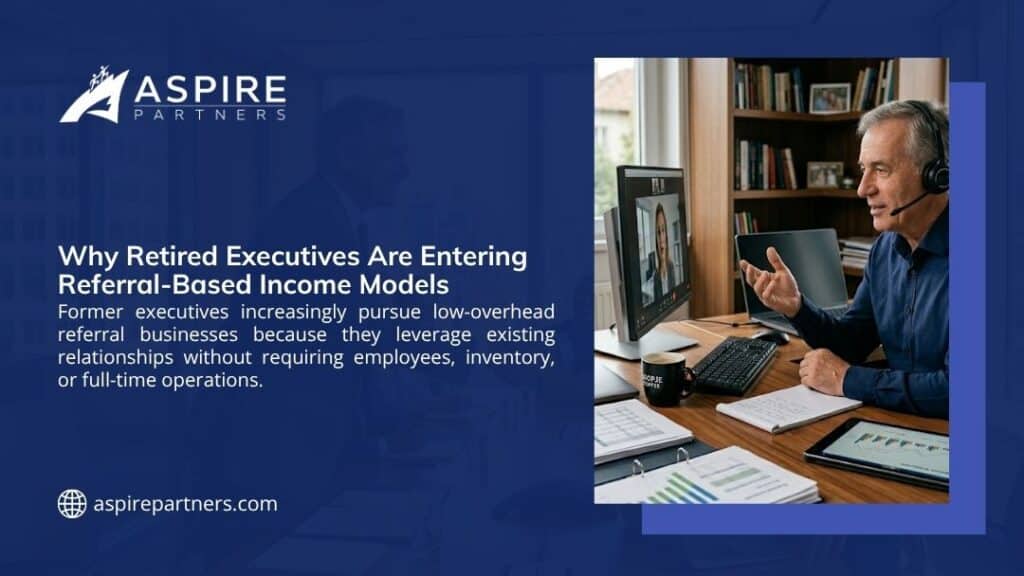
Ethical Considerations When Monetizing Relationships
Ethics matter enormously in relationship monetization. A professional reputation may take decades to build and only moments to damage. That reality explains why trust-based referral models work best when the recommended services produce legitimate value.
Transparency matters. Credibility matters. Vendor quality matters. Professionals should never recommend services they do not trust. The strongest referral ecosystems understand this. They prioritize operational credibility because long-term relationships depend on outcomes.
Aspire Partners emphasizes this operational support structure through its service ecosystem and vendor partnerships. The company positions its professionals as connectors rather than aggressive salespeople.
That distinction lowers reputational risk because the professional is introducing businesses to vetted providers capable of delivering measurable solutions. Trust remains the foundation of the entire model. Without trust, professional network monetization collapses.
Building a Long-Term Financial Safety Net Through Your Network
Many professionals eventually realize their career relationships represent an overlooked financial asset. The challenge is converting that asset into structured recurring income.
Traditional retirement planning rarely discusses relationship capital. Yet business relationships frequently create opportunities unavailable through conventional investment strategies alone.
A well-connected executive may know hundreds of business owners across multiple industries. Those relationships can produce introductions, partnerships, consulting engagements, advisory roles, and referral opportunities for years.
That potential becomes especially important during career transitions. Retirement. Corporate restructuring. Consulting pivots. Economic uncertainty. Professionals increasingly want income models capable of operating alongside existing careers rather than replacing them entirely.
That flexibility explains why low-overhead relationship-based business opportunities continue gaining momentum. The focus shifts from hustle culture toward strategic leverage.
Instead of constantly chasing new customers, professionals can work within trusted networks already built through decades of experience.
What to Look for in a Network Monetization Opportunity
Not every business opportunity deserves trust. Our breakdown of the questions to ask before joining a referral partner program turns that caution into a practical interview script. Professionals evaluating referral-based income models should examine operational support, transparency, vendor credibility, compensation structures, and reputation carefully. The strongest opportunities typically share several characteristics.
- Low upfront investment.
- Clear operational infrastructure.
- Established vendor relationships.
- Transparent compensation.
- Real business value.
- Minimal operational complexity.
- Scalable recurring income potential.
A poor system places pressure entirely on the professional. A strong system handles fulfillment, implementation, audits, customer support, and vendor coordination. That separation dramatically improves scalability.
Aspire Partners highlights these operational advantages through its partner support structure and testimonials from professionals already using the platform. The testimonials consistently emphasize flexibility, recurring income potential, and relationship-based business development rather than traditional selling. That messaging aligns strongly with the needs of experienced professionals seeking low-friction opportunities.
Frequently Asked Questions
Can you make money from your professional network?
Yes. Professionals monetize networks through referrals, consulting, advisory work, affiliate marketing, partnerships, and strategic business introductions.
What is audience monetization?
Audience monetization refers to earning revenue from followers, communities, subscribers, or online audiences through ads, memberships, sponsorships, and digital products.
How does professional network monetization differ from influencer marketing?
Influencer marketing depends heavily on content visibility and followers, while professional network monetization relies more on trust, business relationships, and referrals.
Is referral income considered passive income?
Referral income may become partially passive when recurring commissions continue after the initial introduction.
How do professionals avoid damaging relationships when monetizing networks?
Ethical referral models focus on trusted solutions that create measurable value for the business receiving the recommendation.
What industries work best for referral-based monetization?
Technology services, healthcare administration, lending, operational consulting, payment systems, and cost-reduction services often work well because businesses consistently seek efficiencies in these areas.
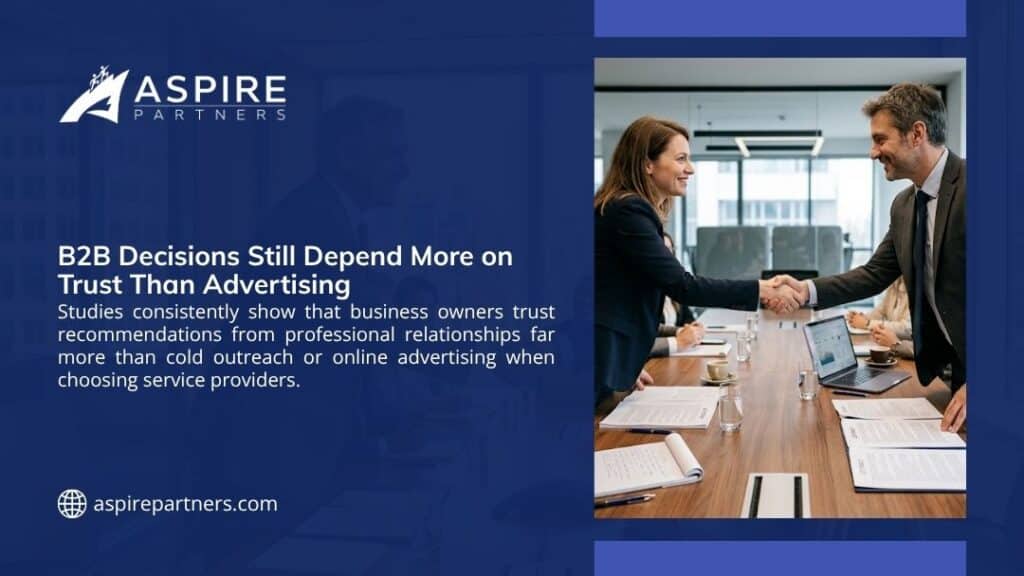
A Smarter Way to Turn Relationships Into Recurring Income
Many professionals spend decades building relationships that quietly hold financial value. The challenge is rarely access. The challenge is structure.
A modern referral-based business model allows professionals to create recurring income from relationships without launching another complex company, hiring employees, leasing office space, or managing fulfillment.
That shift explains why relationship monetization continues gaining attention among executives, consultants, retirees, and advisors. Professional networks already contain opportunities. The right infrastructure simply helps unlock it.
Aspire Partners positions itself within this growing category by giving professionals access to operational support, vendor partnerships, cost-reduction services, and recurring compensation opportunities tied to real business outcomes.
Professionals interested in exploring the model further can review the company overview or connect directly. For experienced professionals searching for a practical way to monetize business relationships without becoming full-time salespeople, the appeal is straightforward.
The relationships already exist. The trust already exists. And that may be the most valuable asset of all.