

Retirement no longer means stepping away from income opportunities. For many professionals, it becomes a chance to turn decades of business relationships into flexible, recurring income without employees, inventory, or large startup costs. That shift explains why business ideas for retirees that leverage your network continue gaining attention among executives, consultants, advisors, and business owners over 50.
In this article, we will explore how retirees use professional relationships to create low-overhead businesses, build residual income, stay professionally active, and pursue retirement opportunities that align with experience rather than physical labor.
Business Ideas for Retirees That Leverage Your Network
The strongest business ideas for retirees rarely begin with a product. They begin with relationships. A retired executive may know CFOs struggling with rising operational expenses. A former healthcare leader may stay connected to clinic administrators. Someone from manufacturing may still have relationships with vendors, plant managers, and logistics contacts. Those relationships carry value because trust takes years to build.
That trust economy now drives many retirement businesses. Instead of opening a storefront or investing heavily in a franchise, retirees increasingly prefer businesses with low startup costs and flexible schedules. Relationship-based businesses fit naturally into that shift because they allow experienced professionals to monetize existing credibility rather than create something entirely new. For a broader comparison of retirement-friendly models, explore low-overhead business choices for retirees by setup burden, time commitment, and income pattern.
The retirement landscape has changed dramatically over the past decade. Inflation pressure, market volatility, and longer life expectancy continue to reshape retirement planning. According to an AARP survey, many adults over 50 now expect to work in some capacity during retirement, either through part-time jobs after retirement, consulting, or self-employment.
According to the U.S. Census Bureau, Americans over 55 continue to represent one of the fastest-growing entrepreneurial demographics in the country. Older entrepreneurs also show higher survival rates than younger founders because experience, networks, and industry understanding reduce risk.
At the same time, many retirees do not want physically demanding work. They want personally fulfilling opportunities that allow them to stay active while maintaining flexibility. That explains the rise of retirement business ideas connected to consulting, advisory work, referral partnerships, and professional networking.
Why Relationship-Based Retirement Businesses Continue to Grow
| Factor | Traditional Retirement Jobs | Relationship-Based Businesses |
| Startup Cost | Moderate to High | Low |
| Physical Demand | Often Moderate | Low |
| Schedule Flexibility | Limited | High |
| Scalability | Limited | Strong |
| Uses Existing Network | Rarely | Directly |
| Residual Income Potential | Minimal | Possible |
| Employee Management | Often Required | Usually Not Required |
Many professionals discover that their greatest retirement asset is not savings alone. It is the network they spent decades building.
Why More Professionals Start a Business After Retirement
Retirement once represented a clear finish line. Today, it looks different. Professionals who spent decades solving business problems often struggle with the abrupt transition into complete inactivity. Some miss professional conversations. Others want supplemental income. Many simply want to remain useful without returning to full-time corporate life.
That shift has fueled interest in retirement businesses, home-based opportunities, and small business ideas for retirees. But here is the problem.
Most retirement business ideas promoted online involve active labor. Freelance writing requires ongoing client work. Pet sitting demands physical availability. Selling online depends heavily on marketing and fulfillment. Real estate often requires aggressive sales activity.
Those opportunities may work for some people, but they do not always align with professionals who already possess decades of business relationships. This is where network-driven businesses stand apart.
Instead of starting from zero, retirees use existing professional trust to create income opportunities. In many cases, the work centers around conversations and introductions rather than operational execution. That model appeals strongly to:
| Professional Background | Why Network Businesses Fit |
| Former Executives | Extensive decision-maker relationships |
| Consultants | Trusted advisory reputation |
| Sales Leaders | Large professional contact base |
| Retired Business Owners | Deep local business credibility |
| Fractional Advisors | Existing client access |
| Healthcare Professionals | Strong referral ecosystems |
A Harvard Business Review discussion on older entrepreneurs noted that experienced founders often outperform younger entrepreneurs because pattern recognition and relationship capital improve decision-making. Older entrepreneurs bring industry expertise, social capital, and management experience that younger founders often lack. That insight directly supports why business ideas for retirees that leverage your network continue to grow in popularity.
The Hidden Asset Most Retirees Overlook
Many retirees underestimate the value of their relationships. Throughout a career, professionals quietly accumulate something younger entrepreneurs spend years trying to build: credibility.
A retired executive who introduces a trusted vendor to a business owner carries influence. A former operations leader who recommends a cost-saving solution receives attention because the relationship already exists. That credibility creates leverage.
In many industries, introductions matter more than cold outreach. Decision-makers prefer conversations with people they already know and trust. Retirees who understand industries, business operations, and organizational challenges naturally become valuable connectors.
That explains why business opportunities for retirees increasingly center around referrals, partnerships, and strategic introductions.
Some retirees build consulting practices. Others pursue senior care business opportunities or elder care business ideas connected to healthcare referrals. Some create niche advisory businesses. Others pursue relationship-based income models tied to operational savings or vendor partnerships.
The structure varies. The principle stays the same. Professional relationships create opportunity. And unlike many startup models, relationship-based businesses often avoid the heavy operational demands that make retirement entrepreneurship stressful.
How Relationship-Based Retirement Businesses Work?
Many retirees hesitate to start businesses because they assume entrepreneurship requires selling, staffing, fulfillment, contracts, inventory, or technical expertise. That assumption prevents many experienced professionals from exploring opportunities that fit retirement far better.
Relationship-driven business models work differently. The retiree identifies a business contact that may benefit from a service. They make an introduction. Specialists handle audits, proposals, implementation, and ongoing support.
The retiree acts as the connector. That structure explains why residual-income business models continue attracting former executives, consultants, and professionals over 50.
For example, some retirees introduce businesses to cost-reduction providers, healthcare optimization services, AI technology audits, logistics savings firms, or operational consultants. When the provider delivers measurable value, the referring partner earns recurring income. This might work especially well for retirees with:
| Existing Relationship Type | Potential Business Opportunity |
| CFO Relationships | Expense reduction referrals |
| HR Contacts | Employee benefit solutions |
| Healthcare Networks | Senior care services business |
| Manufacturing Contacts | Logistics optimization |
| Small Business Owners | Vendor savings partnerships |
| Legal & Finance Networks | Operational consulting referrals |
A growing number of professionals now explore ways to earn residual income from business relationships because the model avoids many traditional startup headaches.
The retiree does not manage fulfillment. The retiree does not negotiate implementation. The retiree does not handle operations. They simply open doors through trusted relationships.

Why Referral-Based Businesses Appeal to Retirees
Many retirees want flexibility more than rapid growth. Traditional startups often require long hours, staffing, operational oversight, payroll management, and constant stress. Franchises may demand six-figure investments before generating meaningful income.
Referral-based retirement businesses reduce much of that pressure. They allow retirees to work part-time while maintaining autonomy. Readers still a few years from leaving their careers can learn about building a business before retirement while they still hold a salaried role. Many operate entirely home-based. Some require little more than conversations and introductions.
That simplicity explains why many retirees prefer business opportunities built around existing networks rather than labor-intensive businesses.
Traditional Franchise vs Referral-Based Retirement Business
| Factor | Traditional Franchise | Referral-Based Business |
| Initial Investment | $50,000–$1,000,000+ (Includes franchise fees & build-outs) | Low (Usually covers software, training, or kit) |
| Staffing Requirements | Usually Required | Rarely Required |
| Operational Complexity | High | Low |
| Physical Location | Often Required | Usually Remote |
| Inventory | Often Required | None |
| Flexibility | Moderate | High |
| Residual Income Potential | Varies | Strong Potential |
That difference becomes even more important for retirees focused on lifestyle balance rather than aggressive expansion. A retiree who spent decades in business may not want another full-time operational role. They simply want meaningful income, flexibility, and continued relevance. And that is why relationship-based retirement businesses continue gaining traction.
Best Retirement Businesses for Professionals With Strong Networks
The strongest retirement businesses often align with previous career experience. A retired healthcare administrator may explore elderly care business opportunities. A former operations executive may pursue referral partnerships connected to business savings. Someone from finance may focus on vendor optimization or advisory work.
The key is alignment. Retirees who understand industries already possess insight that younger entrepreneurs lack.
Retirement Business Ideas That Leverage Professional Relationships
| Business Type | Startup Cost | Flexibility | Residual Income Potential |
| Executive Referral Partnerships | Low | High | High |
| Fractional Consulting | Low | Moderate | Moderate |
| Senior Care Business Ideas | Moderate | Moderate | Moderate |
| Vendor Savings Partnerships | Low | High | High |
| Healthcare Referral Services | Low | High | Moderate |
| Professional Connector Businesses | Low | High | High |
| Advisory Services | Low | Moderate | Moderate |
According to the National Council on Aging, adults age 65 and older are expected to represent about 22% of the U.S. population by 2040, creating rising demand for businesses and services that support older Americans.
Some retirees pursue senior care services business models directly. Others focus on referral-based opportunities tied to healthcare coordination, wellness programs, or operational support.
Meanwhile, professionals with strong business-owner relationships increasingly explore referral models connected to operational savings, AI audits, healthcare optimization, logistics, and vendor cost reduction.
Many executives now look for side hustle ideas for executives with business experience because those opportunities allow them to remain professionally active without rebuilding a business from the ground up.
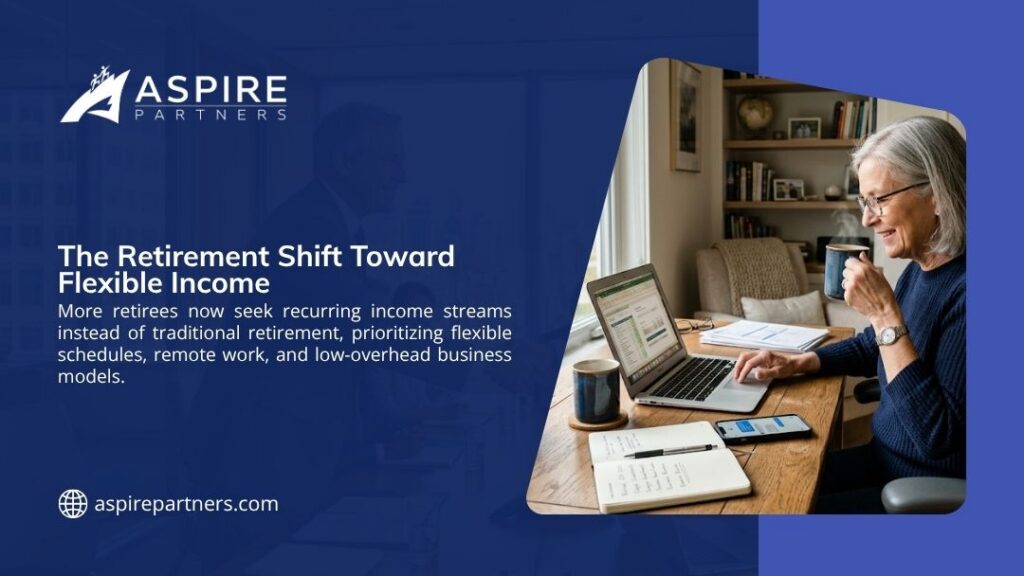
Why Residual Income Matters More in Retirement
Hourly income works differently in retirement. Many retirees discover that active-income businesses become exhausting over time. Consulting projects require continuous work. Freelance writing depends on deadlines. Retail businesses demand operational involvement.
Residual income changes that dynamic. Instead of restarting income generation every month, retirees build recurring revenue streams connected to relationships and long-term business contracts. That distinction explains why referral-based retirement businesses continue expanding.
A retiree who introduces a company to a service provider may continue receiving compensation long after the initial introduction. That recurring structure creates greater predictability and flexibility.
Active Income vs Residual Income in Retirement
| Income Type | Requires Ongoing Daily Work | Long-Term Scalability | Retirement Flexibility |
| Freelance Work | Yes | Limited | Moderate |
| Consulting | Yes | Moderate | Moderate |
| Retail Business | Yes | Moderate | Low |
| Referral Partnerships | Often No | Strong | High |
| Residual Partnerships | Minimal After Setup | Strong | High |
This explains why many retirees now prioritize business models connected to recurring revenue rather than hourly labor. Professionals who spent decades building trusted relationships already possess the foundation.
They simply need the right structure. Some retirees now explore ways to do the work once and get paid for years because recurring income creates greater financial stability during retirement.
How Aspire Partners Fits This Growing Retirement Trend
Aspire Partners operates within a category that continues growing among professionals over 50: relationship-based referral income. Instead of requiring retirees to manage operations, negotiate contracts, or deliver technical services themselves, the model centers around introductions. For a wider comparison of startup paths, see our roundup of seven low-cost retirement businesses.
A professional identifies a business relationship that may benefit from operational savings solutions. Aspire Partners and its vendor network handle the analysis, implementation, audits, and service delivery. That distinction matters because many retirees want low-overhead business opportunities rather than labor-heavy startups.
The company’s structure also differs from traditional franchise models. Many franchise opportunities require significant upfront capital, staffing, physical locations, and operational oversight. Aspire Partners positions itself as a lower-cost alternative centered around introductions rather than daily operations.
Professionals exploring side income ideas for business owners using their network often look for opportunities that preserve flexibility while creating recurring revenue.
Aspire’s service ecosystem includes operational savings evaluations, AI and technology optimization, logistics savings, healthcare solutions, payment systems, SaaS audits, and vendor cost reduction services.
For retirees who prefer relationship-driven business opportunities instead of operational businesses, that structure aligns naturally with how many experienced professionals already operate.
Common Mistakes Retirees Make When Starting Businesses
Retirees often possess the experience necessary to succeed in business. Yet many still choose models that create unnecessary stress.
One of the most common mistakes involves investing too much capital into businesses with uncertain demand. Large franchise fees, retail leases, inventory purchases, and staffing commitments can quickly create pressure during retirement.
Another issue involves choosing businesses that depend entirely on active labor. Some retirees underestimate how exhausting full operational responsibility becomes over time. Businesses requiring constant client work, physical labor, or heavy management often reduce the flexibility retirees originally wanted.
Many also overlook the value of their own networks. Instead of leveraging decades of business relationships, they pursue highly competitive online businesses where trust and experience offer little advantage.
That is why relationship-based retirement businesses often outperform generic startup models for experienced professionals. They build upon the credibility retirees already possess.
What Makes a Good Retirement Business in 2026
Retirement businesses continue evolving alongside broader workforce changes. The best business for retirees in 2026 will likely share several characteristics. The strongest retirement businesses typically combine:
| Characteristic | Why It Matters |
| Low Startup Cost | Reduces financial pressure |
| Flexible Schedule | Supports retirement lifestyle |
| Existing Skill Alignment | Increases confidence and success |
| Relationship-Based Growth | Reduces marketing burden |
| Recurring Revenue Potential | Improves stability |
| Remote Compatibility | Increases convenience |
Professionals who already possess trusted business relationships often hold a major advantage. They do not need to manufacture credibility. They already earned it.

Frequently Asked Questions
What is the best business to start after retirement?
The best retirement business often depends on previous experience, flexible goals, and existing relationships. Many retirees now prefer relationship-driven businesses, consulting, referral partnerships, or senior care business ideas because these models use existing networks instead of requiring heavy startup investments.
How do retirees earn recurring income?
Many retirees build recurring income through referral partnerships, consulting retainers, licensing arrangements, or relationship-based business models tied to ongoing services. Residual-income businesses allow professionals to benefit from long-term contracts rather than one-time transactions.
Can seniors start businesses with low investment?
Yes. Many retirement business ideas require very little upfront capital, especially relationship-driven businesses, advisory services, consulting, referral partnerships, and home-based opportunities.
What businesses work best for retired executives?
Retired executives often succeed in consulting, referral partnerships, operational advisory work, senior businesses, and business development partnerships because they already possess strong professional relationships and decision-maker access.
How can retirees monetize professional relationships?
Retirees often monetize relationships through consulting, introductions, advisory partnerships, operational savings referrals, vendor partnerships, or strategic networking connected to business services.
What are the best home businesses for seniors?
Many seniors prefer businesses that support flexible schedules and low overhead. Consulting, referral partnerships, freelance writing, coaching, and relationship-driven business opportunities continue growing because they operate effectively from home.
Final Thoughts: Experience Still Has Value
Retirement changes routines. It does not erase decades of experience. Professionals who spent years building relationships, solving problems, and earning trust often underestimate how valuable those assets become in today’s relationship-driven economy. Younger entrepreneurs spend years trying to build credibility. Retirees already possess it.
That is why business ideas for retirees that leverage your network continue attracting executives, consultants, advisors, and experienced professionals looking for flexible income opportunities with lower operational stress.
The strongest retirement businesses rarely depend on inventory, storefronts, or complicated operations. They depend on trust. And trust compounds over time.
For retirees exploring business opportunities connected to professional relationships, operational savings partnerships, and recurring revenue, Aspire Partners represents one example of how experienced professionals continue building meaningful income without returning to traditional corporate life.You can explore additional insights, business models, and professional success stories or connect directly to Aspire Partners.