

Most professionals never think of their network as an income source until someone else starts making money from the same kinds of relationships they already have. A retired operations executive introduces a former client to a healthcare savings consultant. Six months later, that introduction still generates monthly commissions.
A fractional CFO connects a manufacturing company with a payroll optimization provider after hearing repeated complaints about rising administrative costs. The provider handles the analysis, contracts, and implementation. The CFO simply opened the door.
A former telecom executive recommends a logistics audit firm to a business owner she has known for years. The company reduces shipping expenses, and the referral turns into recurring income.
None of these people launched startups. None built large sales teams. None invested franchise-level capital. They used relationships they had already spent decades building. That’s the shift happening quietly across modern business. Trusted introductions now carry measurable financial value.
Companies spend heavily trying to reach decision-makers through ads, outbound prospecting, cold email campaigns, and lead gen software. Yet many executives still ignore unsolicited pitches. A recommendation from someone they already know changes the conversation almost immediately. And that creates an opportunity most professionals overlook.
In this article, we’ll break down how to get paid for making business introductions, how referral fees and recurring commissions work, why companies willingly pay for high-quality introductions, and how experienced professionals are turning long-standing business relationships into additional income streams without handling fulfillment, operations, or aggressive selling.
| Key Takeaway | Why It Matters |
| Warm introductions close faster | Trust reduces friction in business decisions |
| Referral models require little overhead | No employees, inventory, or office expenses |
| Residual commissions can compound over time | One introduction may create long-term income |
| Experienced professionals have an advantage | Existing networks become monetizable assets |
How to Get Paid for Making Business Introductions?
The simplest way to understand this model is to think of yourself as a connector rather than a salesperson. Companies spend enormous amounts of money searching for potential customers. Traditional lead gen campaigns often involve advertising costs, outbound prospecting, SDR teams, software subscriptions, and months of follow-up. Yet referrals continue to outperform nearly every acquisition channel because trust already exists before the first conversation begins.
That trust creates economic value. When a business professional introduces a company to a vendor that ultimately saves money, increases efficiency, or solves an expensive operational problem, the vendor often pays a referral fee or success fee for that opportunity.
In some industries, the compensation arrives as a one-time commission. In others, the financial introducer receives monthly residual income tied to the life of the client relationship.
According to research from the University of Pennsylvania’s Wharton School, referred customers are often more profitable and loyal than customers acquired through traditional channels. That research explains why businesses continue to invest heavily in referral ecosystems. Referred customers are both more loyal and more profitable than other customers.
That quote matters because it validates a broader shift inside modern business development. Companies increasingly value relationship-based introductions over cold prospecting. And that opens the door for professionals who already possess years of business relationships.
| Traditional Sales | Referral-Based Introductions |
| Cold outreach (calls/emails) | Warm introductions |
| Long and slow sales cycles | Faster trust development |
| High advertising spend | Lower acquisition costs |
| Pressure-heavy selling | Relationship-based conversations |
| Transactional interactions | Long-term partnerships |
The modern referral economy now extends far beyond affiliate marketing. Consultants, advisors, former executives, and operators often receive compensation for introducing companies to payroll services, software providers, healthcare consultants, logistics specialists, tax recovery firms, and operational savings companies.
The person making the introduction does not necessarily sell the service. That distinction matters. In many referral partnership models, specialists handle the analysis, pricing, implementation, onboarding, and account support. The introducer simply opens the door.

Why Companies Pay Referral Fees for High Quality Introductions
Businesses rarely pay referral commissions out of generosity. They do it because referrals lower risk. A trusted recommendation immediately changes the tone of a conversation. Instead of approaching a stranger, the company enters through an existing relationship. That can shorten decision timelines dramatically.
Research from Nielsen consistently shows that consumers and businesses trust referrals from people they know far more than traditional advertising. Trust removes skepticism, and skepticism is often the biggest barrier inside B2B sales.
| Business Challenge | How Referrals Help |
| Low response rates | Warm introductions improve engagement |
| Expensive customer acquisition | Referral partnerships reduce marketing costs |
| Lack of trust | Existing relationships create credibility |
| Slow sales cycles | Familiarity speeds conversations |
| Weak lead quality | Referral sources send better-fit prospects |
This also explains why many organizations prioritize referral channels inside their customer acquisition strategy. High-quality introductions often convert at a higher percentage than cold leads because they arrive with context and credibility already attached.
Referral-based business development becomes even more valuable in industries where contracts are large, implementation is complex, or decision-making involves multiple stakeholders.
Healthcare consulting, SaaS optimization, payroll analysis, operational savings consulting, and logistics audits all fall into this category. When businesses face large operational expenses, they prefer conversations with providers recommended by someone they trust. And that trust creates a real financial opportunity for professionals with strong networks.
The Difference Between Affiliate Marketing and Business Introductions
Many people confuse affiliate marketing with professional referral partnerships. They share similarities, but the mechanics are completely different.
Affiliate marketing usually relies on online traffic. Bloggers, influencers, or publishers promote products through content, advertising, or social media campaigns. Compensation typically depends on clicks, purchases, or subscriptions.
Business introductions operate differently. The value comes from relationships rather than internet traffic. A financial introducer often knows the business owner personally, understands operational pain points, and makes a direct introduction between decision-makers.
| Affiliate Marketing | Business Introductions |
| Internet traffic focused | Relationship focused |
| Consumer-heavy | B2B-heavy |
| Click-based tracking | Human introductions |
| Transactional sales | Long-term partnerships |
| Smaller payouts | Larger recurring commissions |
| Marketing driven | Trust driven |
Professional referral partnerships also tend to involve larger contract values. For example, a SaaS affiliate might earn a small one-time commission for a software signup. A business introduction involving operational cost reduction may generate recurring monthly commissions over several years.
That long-term element attracts many experienced professionals. Instead of chasing endless new customers, they focus on a smaller number of valuable business relationships. And that changes the economics completely.
How Referral Commission Models Actually Work
Referral partnerships usually follow one of four structures. The first involves a flat referral fee. Once a deal closes, the introducer receives a one-time payment.
The second uses a success fee model tied directly to measurable outcomes. If savings are generated or revenue increases, the introducer earns a percentage.
The third structure involves recurring residual commissions. This model pays the introducer monthly for the life of the customer relationship. The fourth combines multiple approaches.
| Commission Structure | How It Works | Income Potential |
| Flat referral fee | One-time payment per deal | Short-term |
| Success fee | Percentage of savings or revenue | Medium-term |
| Residual commission | Monthly recurring payout | Long-term |
| Revenue share | Ongoing percentage of account revenue | Long-term |
Residual models attract professionals looking for long-term income because commissions may continue long after the initial introduction. That recurring component is one reason relationship-based referral businesses have become popular among former executives, consultants, and entrepreneurial professionals.
Instead of trading time directly for money, they create ongoing revenue streams tied to existing business relationships. Consider a retired healthcare executive who spent years working with regional employers. After introducing a 200-employee company to a pharmacy savings provider, the business has reduced prescription-related expenses substantially. The consulting group manages the implementation, reporting, and vendor coordination. The executive who made the introduction may continue receiving recurring commissions long after the original conversation took place.
That kind of arrangement explains why many experienced professionals now view relationship capital differently than they did ten years ago. Connections that once existed purely for networking can now produce long-term residual income when paired with the right operational partners. But here’s the problem.
Not every referral opportunity is legitimate or sustainable. The strongest programs provide transparency around contracts, commission structures, support systems, and implementation responsibilities.
Weak referral programs usually rely on hype rather than operational substance. That’s why professionals increasingly look for established consulting and vendor networks rather than random affiliate offers.
Industries That Pay for Business Introductions
Referral compensation exists across dozens of industries, though some sectors produce stronger recurring revenue opportunities than others. Software and SaaS companies frequently reward professionals who refer enterprise clients because customer acquisition costs remain high in competitive markets.
Healthcare cost reduction firms often compensate financial introducers who connect employers with savings solutions tied to employee benefits or claims analysis. Operational consulting companies also rely heavily on trusted referrals because executives rarely respond to cold outreach around expense reduction.
| Industry | Why Referrals Matter |
| SaaS and software | High customer acquisition costs (CAC) |
| Healthcare consulting | Trust-sensitive conversations |
| Logistics and shipping | Large operational savings potential |
| Payroll and HR services | Recurring revenue models |
| Expense reduction consulting | Relationship-based selling |
| Tax recovery services | Specialized expertise required |
Consulting-related referral partnerships continue to grow because businesses increasingly outsource specialized operational analysis. Most companies do not possess internal expertise across every expense category. They depend on specialists.
That creates demand for professionals who can connect businesses with proven providers. And unlike traditional sales jobs, many referral-based opportunities avoid quotas, inventory requirements, or aggressive prospecting.
The introducer simply identifies a potential fit and starts the conversation. In practice, these situations often happen naturally. A consultant hears a client complain about rising employee healthcare costs. A former COO notices a company overspending on shipping operations. A retired executive reconnects with a business owner struggling with outdated payroll systems.
Those conversations already happen every day inside professional networks. Referral-based income models simply create a framework where the person making the introduction can participate financially when measurable value is delivered.
Why Experienced Professionals Often Earn More From Referrals
A 25-year executive career creates more than a resume. It creates trust. That trust becomes economically valuable when businesses actively seek qualified introductions.
Experienced professionals already understand how companies operate. They know decision-makers, recognize operational inefficiencies, and understand how budgets work. Those insights make their introductions more credible than generic leads generated through advertising campaigns.
| Professional Background | Referral Advantage |
| Corporate executives | Access to leadership networks |
| Consultants | Existing business relationships |
| Retired professionals | Long-standing credibility |
| Fractional advisors | Active business conversations |
| Entrepreneurs | Broad industry exposure |
Many professionals also prefer referral-based income because it fits alongside existing responsibilities. A consultant may continue client work while earning additional recurring commissions from introductions.
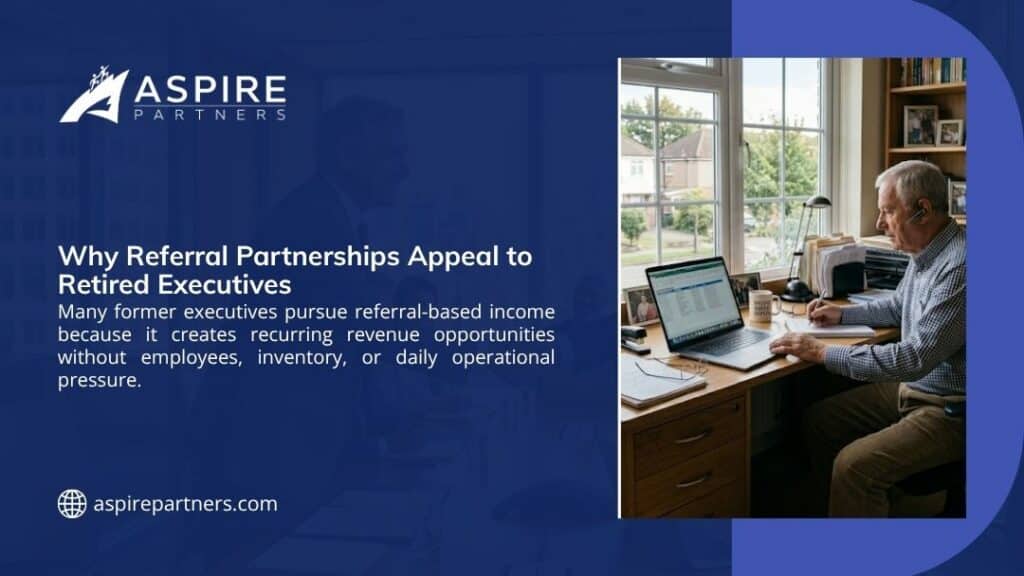
A retiree may maintain professional relationships without launching another full-scale company. An executive may create a financial safety net without leaving corporate employment.
That flexibility explains why relationship-based income models continue to gain traction among professionals seeking diversification. One former software executive may know dozens of mid-sized companies still operating with bloated SaaS expenses. Another consultant may have long-standing relationships with manufacturers struggling with operational waste.
A retired banking professional may continue receiving calls from business owners looking for trusted recommendations years after leaving corporate life.
That’s why referral-based income tends to favor experienced professionals rather than beginners. The model depends less on hype and more on credibility accumulated over time.
How Aspire Partners Turns Business Relationships Into Recurring Income
Aspire Partners operates within this broader referral economy but focuses specifically on cost-reduction consulting and operational savings. The company positions itself as a low-cost alternative to traditional franchise opportunities by allowing professionals to monetize their business relationships without handling implementation, fulfillment, or account management.
Instead of requiring massive upfront investment, Aspire Partners centers its model around introductions. For other options with similarly modest startup costs, browse our guide to low-cost businesses for retirees. Professionals identify businesses that may overspend on operational expenses and connect them with Aspire’s vendor network.
From there, specialists manage the audits, analysis, proposals, negotiations, and implementation process. That structure appeals to professionals who want additional income without building a traditional consulting company from scratch.
Aspire Partners also speaks directly to executives, business owners, retirees, and consultants who already possess years of industry relationships.
For professionals exploring additional revenue opportunities, the company publishes educational resources focused on topics like side income opportunities for executives and strategies to monetize professional networks.
Readers interested in executive-focused income ideas can review Aspire’s perspective on side income opportunities for experienced professionals. Business owners looking to diversify revenue streams can also learn about network-driven side income strategies.
The recurring-income component represents one of Aspire’s strongest positioning advantages. Rather than emphasizing one-time payouts, the company highlights the possibility of long-term commissions tied to ongoing client relationships.
Aspire also discusses how professionals may earn residual income from business relationships without handling the technical delivery side of consulting engagements. That model resonates strongly with professionals seeking scalable income rather than transactional consulting work.
The Simple Referral Process Behind the Aspire Model
Aspire’s structure remains relatively straightforward.
| Step | What Happens |
| Identify opportunity | Recognize businesses with operational expenses |
| Make introduction | Connect decision-makers with Aspire |
| Specialist evaluation | Vendor partners conduct audits and analysis |
| Implementation | Solutions are executed by specialists |
| Compensation | Referral partner earns ongoing commissions |
This structure matters because it minimizes operational complexity for the introducer. The professional does not manage fulfillment, customer support, or technical consulting. That separation allows many participants to operate the model alongside existing careers.
Common Mistakes People Make With Referral Partnerships
Many professionals underestimate the importance of alignment. Not every introduction creates value. Strong referral partnerships depend on fit, trust, and credibility.
| Common Mistake | Long-Term Consequence |
| Sending weak referrals | Loss of trust |
| Prioritizing commissions over fit | Relationship damage |
| Working with poor vendors | Reputation decline |
| Lack of transparency | Legal and ethical risk |
| No follow-up process | Missed opportunities |
The strongest financial introducers treat introductions carefully. They protect credibility. They avoid overselling. And they work only with organizations capable of delivering measurable value. That reputation-first approach matters because referral businesses depend heavily on trust. Without trust, the entire model collapses.
Legal and Ethical Considerations Around Referral Fees
Referral compensation remains legal in many industries, but compliance requirements vary. Some regulated sectors restrict referral payments or require disclosures. Financial services, healthcare, insurance, and securities industries often involve stricter oversight.
Professionals should always review local regulations, tax implications, and disclosure requirements before participating in referral compensation programs.
According to the Federal Trade Commission, transparency around compensation relationships remains essential when recommendations influence consumer decisions. Referral income may also create tax obligations. The Internal Revenue Service generally treats referral commissions as taxable income.
| Compliance Area | Why It Matters |
| Compensation disclosure | Maintains transparency |
| Industry regulation | Some sectors limit referral fees |
| Tax reporting | Referral income is taxable |
| Written agreements | Clarifies expectations |
| Ethical recommendations | Protects professional reputation |
Strong referral partnerships prioritize integrity. The best introducers recommend services they genuinely believe can help the business. That ethical alignment strengthens relationships rather than exploiting them.
Can You Build Long-Term Income From Business Introductions?
In many cases, yes. But sustainable referral income rarely happens overnight. Long-term success depends on credibility, consistency, relationship quality, and alignment with strong service providers.
Professionals with deep networks often possess a major advantage because trust already exists. And trust remains difficult to replicate. Many referral-based income models also scale differently from traditional consulting work.
Instead of billing hourly, the professional benefits from recurring client relationships created through introductions. That difference changes how income compounds over time.
| Traditional Consulting | Referral-Based Residual Income |
| Income tied to hours worked | Income tied to relationships |
| Constant client delivery required | Specialists handle fulfillment |
| Active operational management | Lower operational involvement |
| Revenue resets monthly | Residual commissions may continue |
For some professionals, this model becomes supplemental income. For others, it evolves into a significant long-term revenue stream. Retired executives sometimes use referral partnerships to remain connected to the business world without managing employees or daily operations.
Consultants often use introductions to diversify income beyond client retainers. Corporate professionals may view recurring commissions as a financial buffer during uncertain economic periods. And that’s why relationship capital has become increasingly valuable in modern business.

Frequently Asked Questions
Can you legally get paid for making business introductions?
Yes, many industries allow referral commissions and success fees, though regulations vary depending on the sector and jurisdiction. Professionals should always review legal and compliance considerations before participating.
What is a referral fee?
A referral fee is compensation paid to someone who introduces a new customer, client, or business opportunity that leads to revenue or measurable value.
What is a success fee?
A success fee is compensation tied directly to a completed result, such as generated savings, closed business, or completed contracts.
What industries commonly pay referral commissions?
Software, consulting, logistics, operational savings, payroll services, healthcare consulting, and financial services frequently use referral-based compensation structures.
Do you need sales experience to earn referral commissions?
Not always. Many referral partnerships focus on introductions rather than traditional selling. Specialists often handle proposals, implementation, and account management.
Are referral commissions taxable?
In most cases, yes. Referral income generally counts as taxable business income.
Why Relationship Capital Has Become a Modern Income Stream
Professional relationships once served mainly as career leverage. Today, they often function as economic assets. Businesses increasingly value trusted introductions because cold outreach continues to lose effectiveness across crowded markets.
That shift created legitimate opportunities for professionals who understand industries, maintain strong relationships, and recognize operational challenges companies face every day.
For many people, referral partnerships provide something traditional side hustles cannot. They allow professionals to build income from the experience they already possess. No storefront. No inventory. No massive franchise investment. Just relationships, credibility, and strategic introductions.
Aspire Partners positions itself within that growing economy by helping professionals connect businesses with operational savings solutions while avoiding the burden of fulfillment and implementation.
Professionals interested in learning more about Aspire’s relationship-based income model, operational services, or partner opportunities can connect with the company directly here.
And for experienced professionals looking for a lower-risk alternative to traditional business ownership, that model may offer a practical way to turn decades of networking into recurring long-term income.