

If you’re looking for a flexible business you can run alongside a full-time job, start with the constraint that matters most: limited time. The strongest options use skills, relationships, or assets you already have, avoid unnecessary fixed costs, and let you control when the work happens.
They also make the work boundary clear: what you must personally deliver, how quickly customers expect a response, and whether each payment depends on another billable hour.
What Makes a Side Business Flexible?
“Flexible” can mean more than working from home. It may refer to control over your schedule, location, workload, response time, and delivery responsibilities. A business can have low startup costs and still become demanding if customers expect instant replies, regular fulfillment, or fixed appointment times.
Before choosing an option, ask four practical questions: Can the work happen outside employer hours? Can you pause without losing every source of income? Does the model require you to deliver everything personally? And are the ongoing costs small enough to justify testing it?
Why Some “Flexible” Side Businesses Become Another Job
Scroll any list of businesses to start while working full-time, and you get freelance writing, virtual assistant work, home-based e-commerce, and web development. Many are legitimate, but flexibility is not the same as low effort. Freelance writing, virtual assistant work, consulting, and online stores can all fit around a job, yet each still has delivery, client, fulfillment, or customer-service obligations.
Experienced professionals often already have the skills and relationships needed to begin. The tighter constraints are calendar space and reputation, because anything you bring to people you know reflects on you. A better-fitting model may let you contribute judgment and introductions while another team handles specialist delivery.
Four Filters for a Business You Can Run After Work
1. Low weekly hours. Can it live in evening blocks and a Saturday morning? 2. Limited fixed cost and upfront exposure. Can you test demand without inventory, a lease, employees, or a large cash commitment? 3. Uses skills you already have. Not a new craft learned on nights and weekends. 4. A repeatable revenue path. Can the model produce repeat work, retainers, product sales, or qualifying compensation without restarting from zero every Monday?
These filters are for comparison, not proof that one option is best for everyone. Freelance writing may offer schedule control but still depends on deadlines. Virtual assistant work can be flexible while remaining highly reactive. E-commerce may automate orders without removing sourcing, marketing, shipping, or customer service. Consulting uses your expertise directly, while an introduction-focused model may reduce the amount of technical delivery you personally perform.
Comparing Flexible Business Models
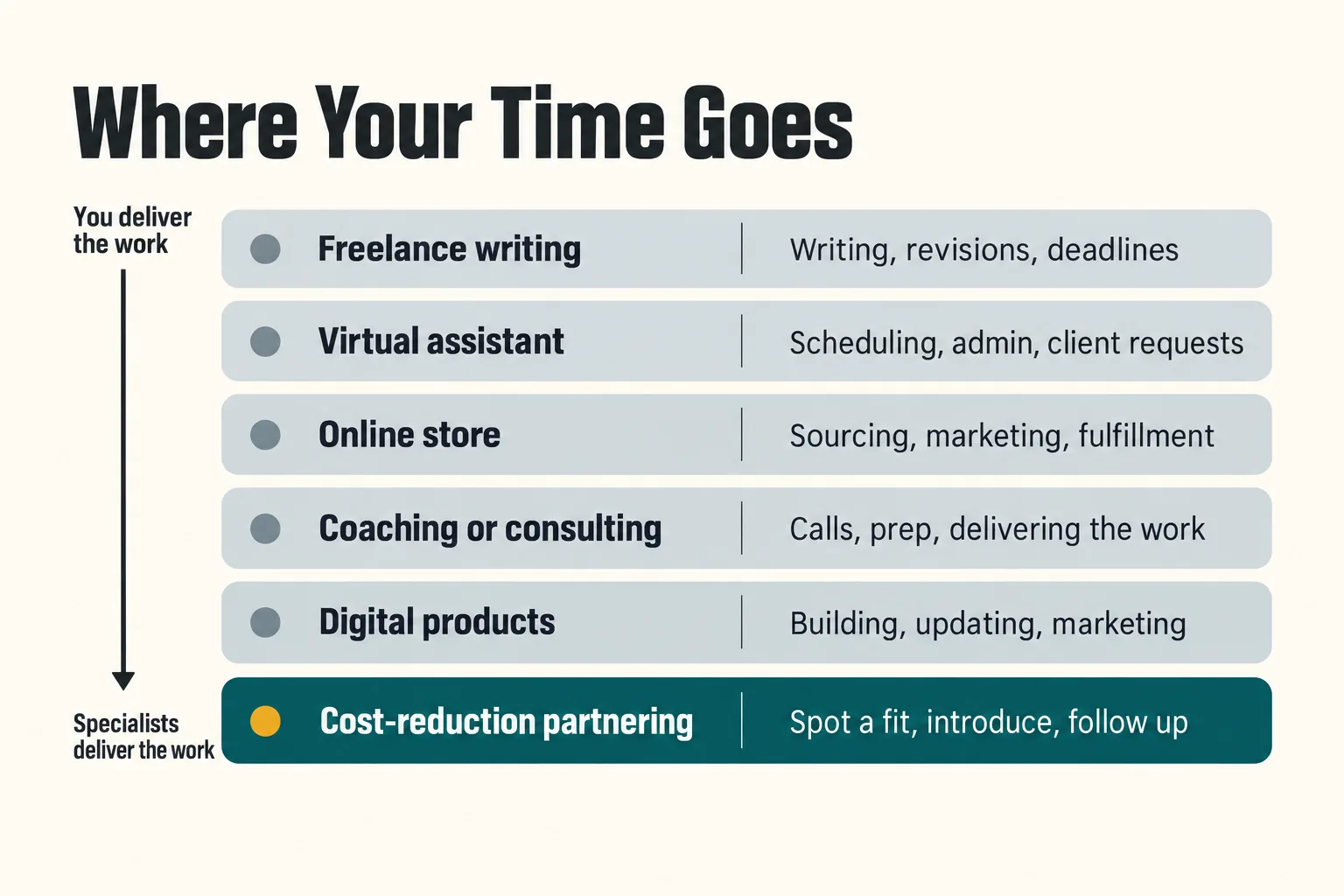
| Model | Where your time goes | Main ongoing burden | Typical revenue pattern |
|---|---|---|---|
| Freelance writing and content work | Writing, revisions, deadlines, and client communication | Finding clients and meeting delivery dates | Project fees or retainers tied to delivery |
| Virtual assistant services | Scheduling, administration, and client requests | Response windows and reactive work | Hourly pay or a monthly retainer |
| Online store | Sourcing, marketing, fulfillment, and support | Inventory, platform costs, and customer service | Product sales |
| Coaching or consulting | Calls, preparation, recommendations, and delivery | Your personal availability and expertise | Sessions, projects, or retainers |
| Digital products or workshops | Building, updating, marketing, and supporting the offer | Upfront creation and audience development | Product, course, or workshop sales |
| Cost-reduction partnering | Identifying a possible fit, making an introduction, and following up | Relationship quality, accurate communication, and account eligibility | Conditional compensation under applicable terms |
No single model wins on every filter. Cost-reduction partnering changes the delivery burden: the professional makes a relevant introduction while specialists handle the applicable detailed work. It still requires judgment, accurate communication, and follow-up. For more background, read about the referral-based business model for professionals.
Check Your Employment Agreement First
Before anything else, read your agreement for noncompete, moonlighting, conflict-of-interest, confidentiality, nonsolicitation, and intellectual-property terms. Whether you can run a side business depends on the contract, your employer’s outside-business policy, and applicable state law. The GAO report on noncompete agreements provides useful background, but it is not a substitute for state-specific legal advice.
Keep the Side Business Separate From Your Job
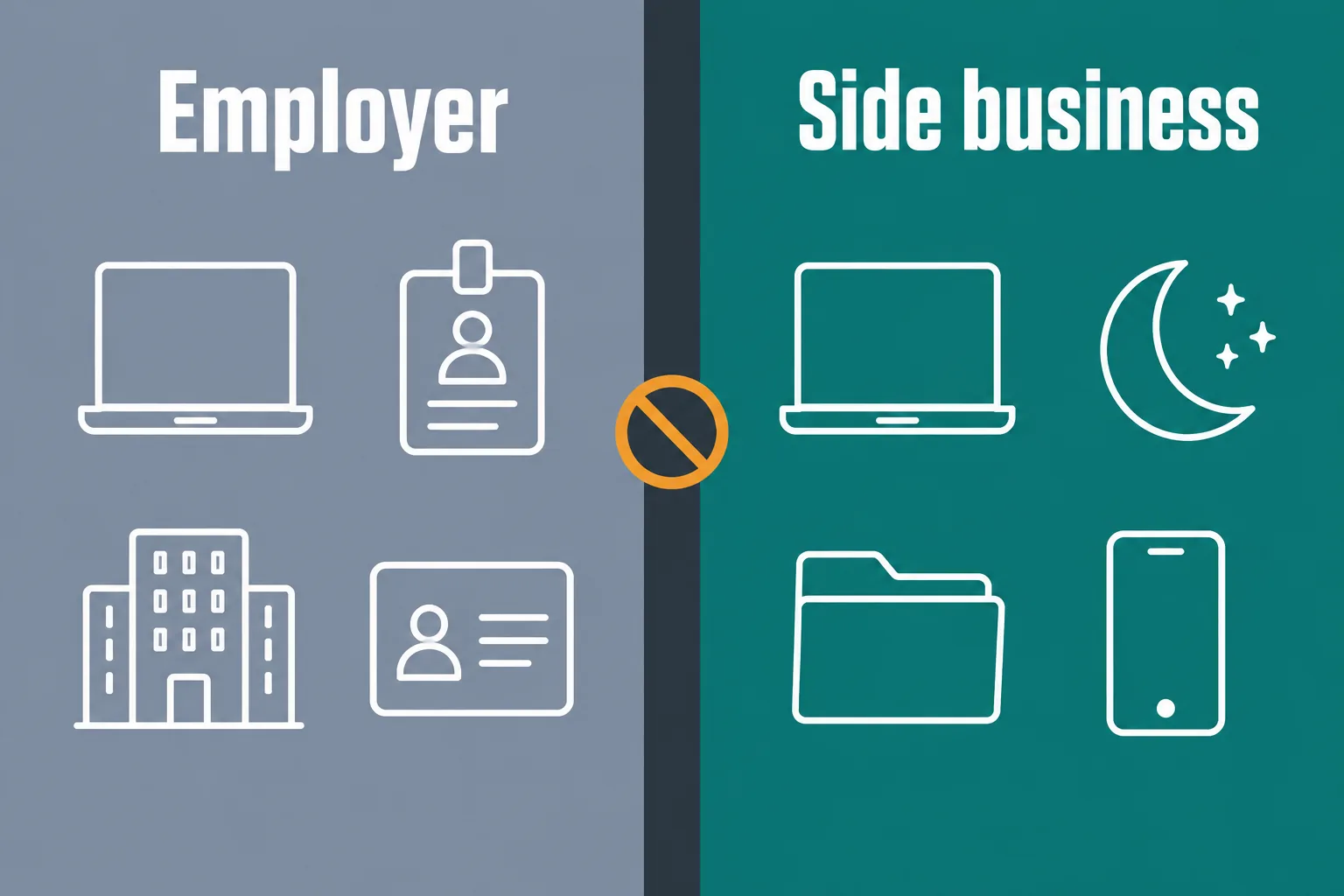
Use personal devices and accounts, work outside employer time, and keep side-business records separate. Do not reuse confidential information, employer-owned contacts, paid software, or company equipment. If potential customers overlap with your employer’s clients or market, obtain written guidance before proceeding.
How Cost Reduction Partnering Works
Companies may have opportunities to reduce operating costs in areas such as software, healthcare, shipping, technology, or vendor agreements. Aspire Partners describes an introduction-focused model in which professionals identify a possible fit while Aspire Partners and its vendor network handle the applicable specialist work. You can review Aspire’s business cost-reduction services before deciding whether the model fits your background.
1. Identify a company in your network that may be overspending or facing a relevant operating-cost problem. 2. Ask whether the decision-maker is open to a conversation. You are not responsible for the technical proposal, negotiation, or implementation. 3. Submit the referral through the current Aspire process. 4. Aspire Partners and its vendors handle the applicable discovery, analysis, recommendations, presentations, agreements, and approved implementation. 5. If the referral qualifies and the applicable service conditions are met, compensation may be available. Amount, timing, and duration vary by service, account, and agreement.
Many business-facing solutions may have no upfront cost where applicable, with fees tied to savings or recovery in the relevant arrangement. The Aspire Partners Pro membership is separate and is currently listed at $97 per month. The model may fit around a full-time job because the technical work is handled by Aspire Partners and its vendors; the professional still contributes judgment, communication, and follow-up.
What Happens After an Introduction
The exact work depends on the service. Current Aspire service descriptions include technology audits, preventative care, shipping solutions, medical recovery, legal protection, commercial payments, and other business services. In a cost-review context, specialists may examine contracts, invoices, operating expenses, or recovery opportunities; learn more about what a business savings audit involves.
Aspire Partners and its vendor specialists handle discovery, analysis, recommendations, agreements, and approved implementation. The professional is not expected to perform the technical audit or become the service provider. Results, eligibility, fees, and savings vary by company and service. Do not promise a tax result, regulatory status, savings percentage, or specific outcome unless current approved documentation supports it.
Taxes, Records, and Separating Business Finances
If you participate as an independent contractor, tax treatment depends on your business structure and personal circumstances. A single-member LLC that has not elected corporate treatment is generally a disregarded entity for federal income-tax purposes, and its activity is usually reflected on the owner’s federal return, often on Schedule C. Review the IRS guidance on single-member LLCs.
Related readingHow to Transition From Corporate Job to ConsultingRead the guide →The IRS says net earnings from self-employment of $400 or more generally require self-employment tax and Schedule SE. Review the IRS self-employment tax guidance, keep income and expenses organized from the start, and ask a tax professional whether estimated payments or a separate business account make sense for you. This is general information, not individualized tax advice.
How the Income Pattern Differs From Hourly Side Work
Hourly and project-based businesses tie payment directly to work you deliver. In an introduction-focused model, compensation depends on qualifying activity, service terms, account status, and the revenue or verified result that triggers payment. A qualifying account may continue generating compensation while it remains active and the agreement’s conditions are satisfied, but payments can change, decline, or end.
That is potential recurring compensation, not guaranteed passive income. No payment amount, duration, or outcome should be treated as promised or typical.
Who This Business Model Fits
Good fit: experienced professionals with relevant B2B relationships, access to decision-makers, sound judgment about when an introduction is appropriate, and a small, consistent block of time for communication and follow-up. Consultants, fractional CFOs, controllers, COOs, B2B sales professionals, business advisors, and retired or recently exited executives may recognize the model because they already understand business problems and decision-making.
Poor fit: anyone expecting immediate income, guaranteed monthly payments, or a business that requires no ongoing effort. It may also be a poor fit if you want to build and deliver the service personally rather than introduce a specialist provider.
Before Joining a Paid Partner Program
Review the monthly membership fee, independent-contractor status, compensation trigger, account eligibility, referral-registration process, cancellation and termination terms, and what happens if a customer stops using a service. Read the current program agreement before joining. Compensation is conditional under the applicable program terms, and recurring payments should not be treated as guaranteed lifetime income.
Frequently asked questions
Can I Run a Business While Working Full-Time?
What Makes a Business Flexible?
Which Business Model Is Best for Someone With a Full-Time Job?
How Does Cost-Reduction Partnering Work?
Is Cost-Reduction Partnering Passive Income?
What Does It Cost the Business and the Partner?
Explore the Model Before You Commit
If you have relevant business relationships and want to assess an introduction-focused model, review the Aspire Partners Pro program for the current $97/month price, U.S. eligibility, and applicable terms before applying.
Disclosure: Aspire Partners Pro is a paid partner program. Compensation is conditional and is not guaranteed.